

A critical look at how CRO damages digital experience when tests are disconnected from brand, usability and long term value.
4 mins read
The symptom
Conversion optimisation often starts with good intent. Test, learn, improve. Remove friction. Increase revenue.
But in many digital products, the experience slowly gets worse. Buttons become louder. Copy becomes more aggressive. Urgency appears everywhere. Screens become dense with persuasion. Every change can be defended by one test, but the whole experience starts to feel less trustworthy.
Why it happens
CRO is attractive because it promises visible improvement. Small changes can produce measurable lifts. That is valuable, especially in e-commerce and performance driven environments.
The risk starts when conversion becomes the only lens. The team optimises individual elements while the wider experience, brand and user relationship receive less attention.
Evidence stack
Nielsen Norman Group describes deceptive patterns as designs that push users into actions that are not in their best interest, noting that they can boost conversions but are unethical and legally problematic.
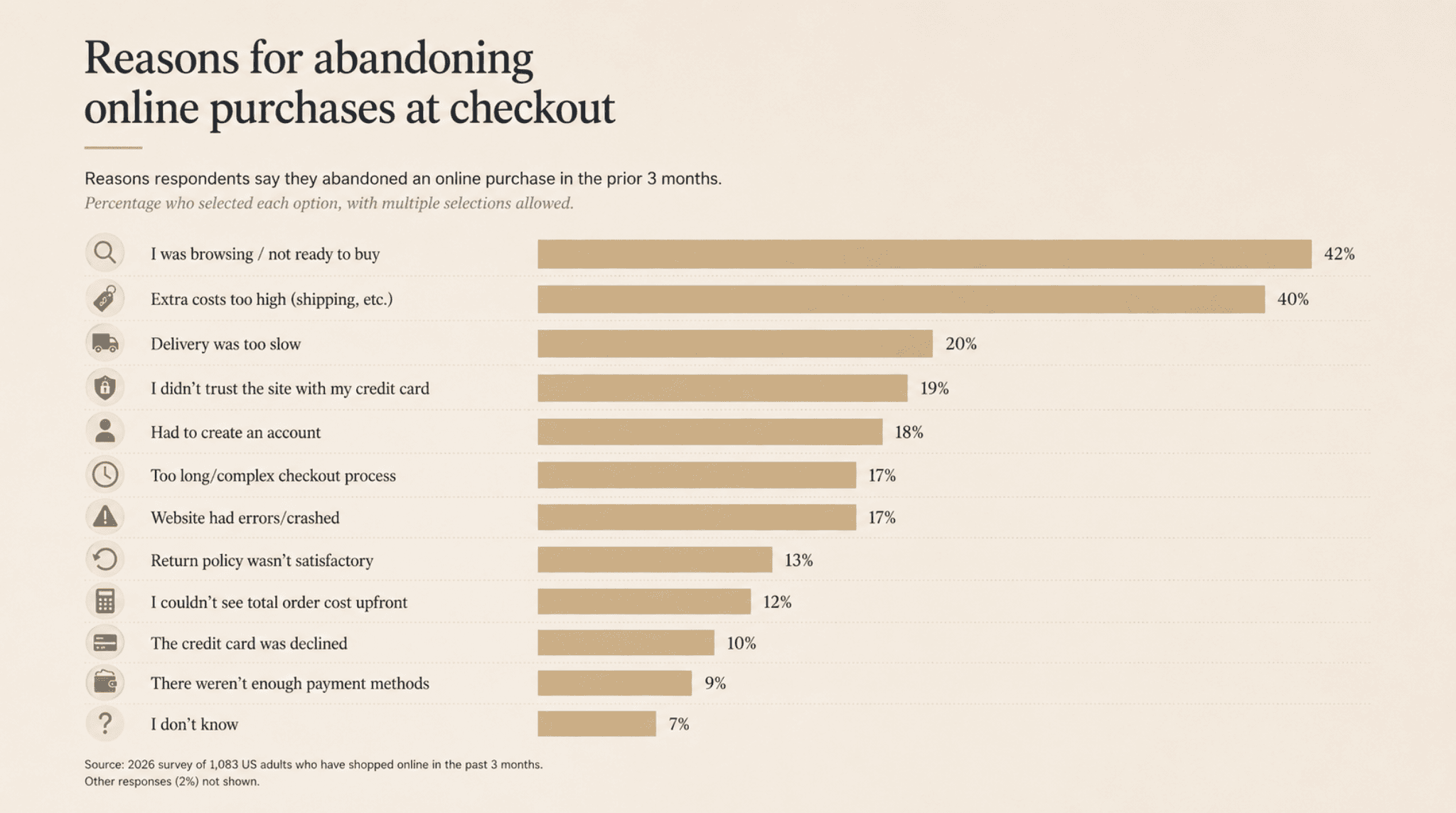
The European Commission's Digital Fairness work show that regulators are paying closer attention to manipulative online design. Baymard's e-commerce UX research also reinforces that conversion depends on reducing real friction, not adding pressure.
The hidden cost
A test can improve immediate conversion while harming trust. It can increase clicks while lowering satisfaction. It can raise urgency while weakening brand preference. It can make one step perform better while making the overall journey feel worse.
That is the danger of local optimisation. The part improves. The system weakens.
Where CRO goes wrong
CRO goes wrong when design becomes test material instead of a coherent system. It goes wrong when significant results get more authority than strategic judgment. It goes wrong when dark patterns are normalised because the dashboard rewards them.
It also goes wrong when no one defines what should never be tested away. Strong brands need non negotiable principles around clarity, accessibility, tone, trust and visual hierarchy.
What works
Good optimisation starts with better questions. What friction are users actually facing. Which behaviour do we want to support. Which brand principles must stay intact. Which metric is useful, and which metric could mislead us.
The strongest CRO programmes test within a design system. They use qualitative and quantitative evidence. They review impact across the journey, not only one screen. They stop tests that may win short term but weaken the relationship.
The Sandstone view
Conversion optimisation should make the experience clearer, not more desperate.
At Sandstone, we connect CRO to design, brand, data, technology and AI. The goal is not to win every test. The goal is to build digital experiences that convert because they are useful, credible and easy to trust.
Optimisation without vision hollows out. Optimisation with direction builds value.
FAQ
Is conversion optimisation bad for design?
No. CRO becomes harmful when it is disconnected from brand, usability, accessibility and long term customer trust.
What is a dark pattern?
A dark pattern is an interface choice that manipulates users into actions they might not otherwise choose.
How should teams balance CRO and design?
They should test inside clear design principles and measure both immediate conversion and wider experience impact.






Newsletter
Sign up to receive occasional updates with insights on strategy,
brand, technology, marketing and AI connected as one system for growth.
Thoughtful updates, sent occasionally. Unsubscribe whenever you like.
Let’s start a conversation
Quick links
Offices

UAE

Morocco

The Netherlands
© 2026 - All rights reserved for Sandstone Project Management Services L.L.C.