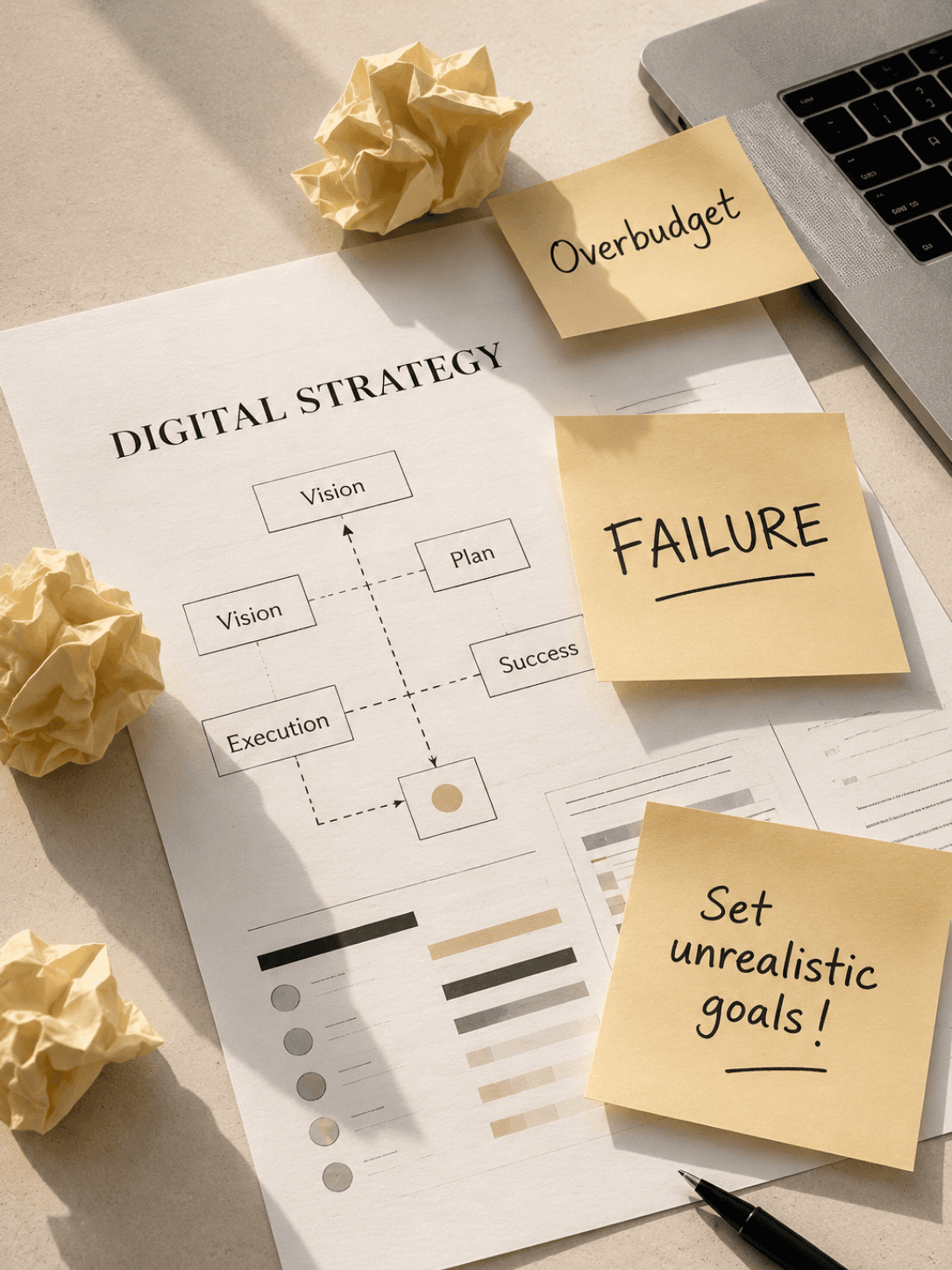
A field note on why strategic digital plans collapse when they are not translated into decisions, ownership and delivery structure.
6 mins read
What we see
Many digital strategies fail before anyone sees the website, campaign, dashboard or platform.
They fail in the room. In unclear priorities. In vague ownership. In the gap between what leadership agrees to and what teams are actually able to execute.
The document may look strong. The roadmap may look complete. The ambition may be right. But if the strategy is not translated into decisions, behaviour and delivery structure, it is already fragile.
The visible symptom
The first signs are easy to recognise. Scope keeps moving. Teams interpret the same goal differently. Technology choices are made before the operating model is clear. Brand decisions are reopened during development. Marketing plans arrive after the platform structure is fixed.
Nothing has launched yet, but the strategy is already losing coherence.
The root cause
The problem is not that organisations lack ideas. The problem is that they confuse direction with execution readiness.
A strategy says where to go. An operating model defines how the organisation will move. Without that second layer, strategy stays abstract. It does not tell teams what to prioritise, what to stop doing, who decides, what must stay consistent and where speed is allowed to override perfection.
Evidence stack
McKinsey's work on data and AI transformation repeatedly points to operating model, adoption, leadership and workflow redesign as conditions for value. The same logic applies to digital strategy. Tools and platforms do not create impact when decision rights and adoption are unclear.
HBR's work on data driven decisions also warns that organisations often overfocus on what is measurable and underfocus on what actually matters. That becomes visible before launch when teams optimise individual parts without a shared definition of success.
Where strategy breaks
First, the business objective stays too broad. Everyone agrees on growth, relevance or efficiency, but no one defines what must change in behaviour or capability.
Second, the platform becomes the strategy. The chosen CMS, commerce stack or automation tool starts driving the conversation. Technology becomes the centre before the operating problem is understood.
Third, ownership is unclear. Strategy, brand, development and marketing all have a role, but no one owns the whole system. That creates local optimisation and slow escalation.
Fourth, the launch is treated as the finish line. In reality, launch is the moment the operating model starts being tested.
What works
Strong digital strategies translate ambition into decisions. They define what success means, which tradeoffs are acceptable, who owns which part of the system and how performance will be interpreted after launch.
They also make complexity visible early. What needs to be standardised. What can remain flexible. Which teams need to change their workflow. Which data is required. Which parts of the stack are strategic and which are replaceable.
A good strategy reduces interpretation. It does not remove creativity. It gives it direction.
The Sandstone view
Digital strategy fails when it is treated as a document instead of a system of choices.
At Sandstone, we connect strategy, brand, technology, marketing and AI before execution gets too far ahead. That creates fewer surprises, clearer ownership and a stronger route from ambition to performance.
A strategy is not ready when everyone likes the idea. It is ready when the organisation knows how to act on it.
FAQ
Why do digital strategies fail before launch?
Because teams agree on ambition but not on priorities, ownership, governance and execution rhythm.
What is the difference between strategy and operating model?
Strategy defines direction. The operating model defines how teams make decisions, collaborate and deliver.
How can organisations reduce launch risk?
They should clarify outcomes, decision rights, technical constraints, brand rules and performance measures before production begins.





Newsletter
Sign up to receive occasional updates with insights on strategy,
brand, technology, marketing and AI connected as one system for growth.
Thoughtful updates, sent occasionally. Unsubscribe whenever you like.
Let’s start a conversation
Quick links
Offices

UAE

Morocco

The Netherlands
© 2026 - All rights reserved for Sandstone Project Management Services L.L.C.